



Insight
Raff Di Meo – Web Development
#NextGenCreatives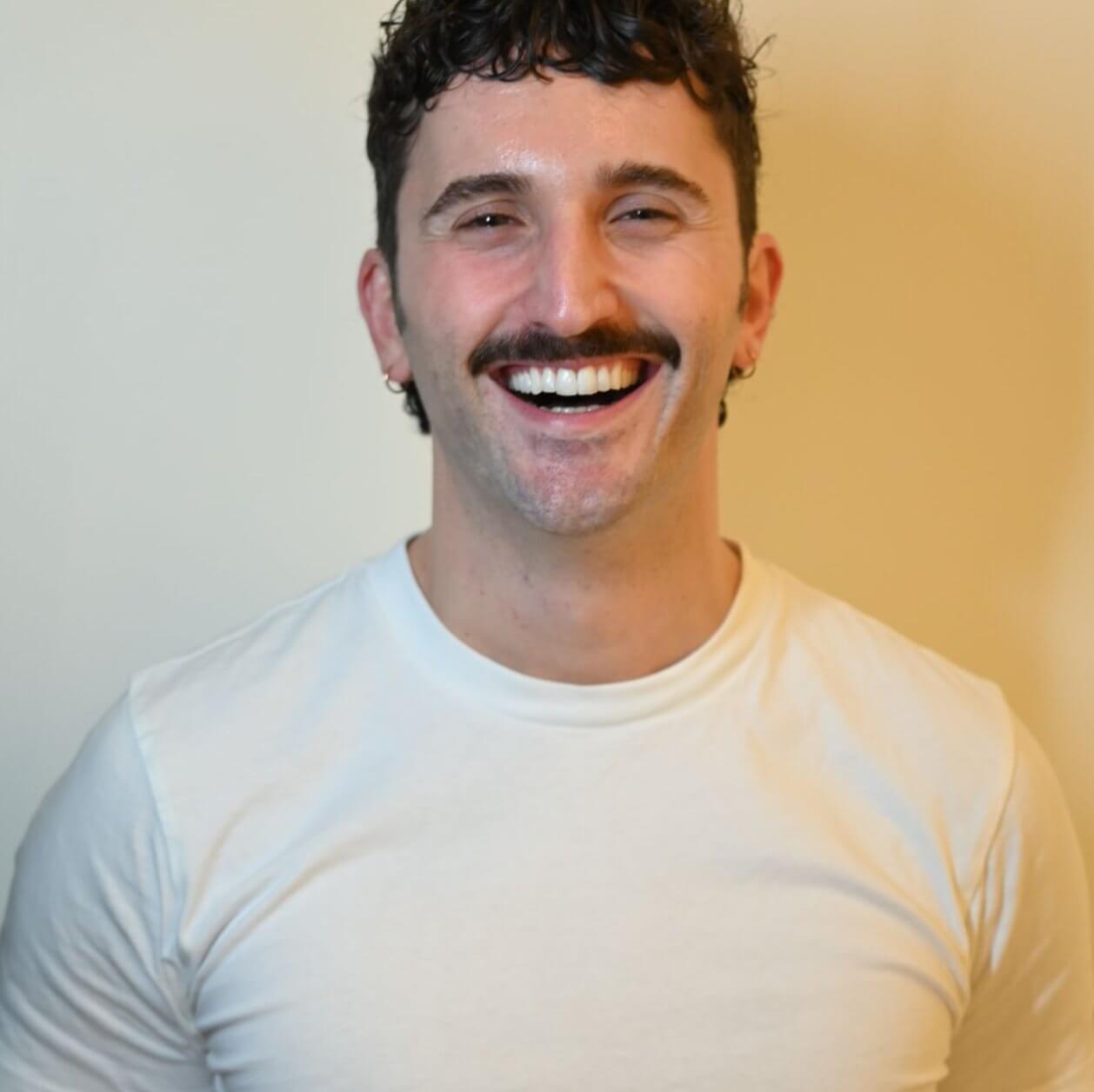
Why Designers Need to Think Like Curators in an AI-First World
Raff Di Meo does not hesitate when asked about AI.
“You definitely need to embrace it,” Raff says. “It’s better to understand what you’re dealing with than ignore it.”
We are sitting just after their workshop at SAE London, where Raff has spent the past hour pushing students far beyond the idea of AI as a simple chatbot. What they saw instead was something closer to a new way of working.
In less than an hour, students had built a working prototype for a healthcare dashboard. Not a concept. Not a sketch. Something usable.
For Raff, that shift is already redefining what it means to be a designer.
From economics to UX design
Raff’s path into design was not traditional.
Their background is in economics, followed by experience in HR, before moving into design across agencies, startups and large organisations.
“I’ve worked across lots of different industries,” Raff says. “And that’s actually helped me a lot.”
That breadth is now becoming an advantage.
In a world shaped by AI, generalists are gaining ground.
“Being very broad in your skill set is great,” Raff explains. “Especially now, where generalists are definitely winning.”
Their work has included projects for charities such as Dogs Trust and Crisis, as well as large-scale e-commerce systems used by global retailers.
But the common thread is not the industry.
It is problem-solving.
Beyond the chatbot
One of the biggest misconceptions Raff sees is how people think about AI.
“Everyone associates AI with a chatbot,” Raff says. “But there’s so much more than that.”
Their workshop focused on moving students beyond simple prompts and into structured thinking.
Instead of asking vague questions, students learned how to break down problems, define users and build solutions with specificity.
“You need to go beyond a simple prompt,” Raff says. “Otherwise you just get generic results.”
In practice, that meant designing for a real-world scenario, a nurse managing multiple patients, and using tools like Figma to rapidly prototype a usable interface.
The result was not just faster work.
It was more focused work.
We’ve always built on what came before
For all the talk of AI disrupting creativity, Raff is quick to reframe the conversation.
Design has always been iterative.
“We look at what other people have done,” Raff says. “We do competitive analysis. We take inspiration.”
In UX design, this is not a weakness.
It is a principle.
Users expect familiar patterns. Navigation, layouts, interactions. Consistency reduces friction.
“If every website worked differently, it would be chaos,” Raff says.
AI, in this context, becomes another tool for exploring ideas, not replacing them.
It accelerates discovery, but decisions still sit with the designer.
The shift from creator to curator
As AI tools become more capable, Raff sees the role of designers evolving.
“We’re moving towards a more curated role,” Raff says.
Instead of building everything from scratch, designers will increasingly guide, refine and validate outputs.
The value lies in judgement.
“You still need humans to check that everything aligns with what you actually want,” Raff explains.
In an AI-driven workflow, that role becomes even more important.
No excuses not to learn
For students entering the industry, Raff’s advice is direct.
“If you don’t know where to start, ask AI where to start,” Raff says.
The barrier to entry has never been lower.
Tools are accessible. Knowledge is available instantly.
That also means expectations are higher.
“If you don’t have AI projects in your portfolio, it’s going to be hard to get an interview,” Raff says.
Employers are not just looking for creativity.
They are looking for adaptability.
Creativity isn’t going anywhere
For all the disruption, Raff is clear on one thing.
AI does not remove creativity.
It changes how it is applied.
“You can still be creative with AI,” Raff says. “You’re just thinking about problems in a different way.”
By removing repetitive tasks, AI allows designers to focus more on ideas, structure and experience.
But only if they are willing to engage with it.
The future belongs to those who adapt
The pace of change is difficult to predict.
“I wasn’t doing the same thing I’m doing now two months ago,” Raff says.
What matters is not predicting the future.
It is staying flexible enough to move with it.
The tools will continue to change.
The role of the creative will continue to shift.
But the need for human judgement, perspective and decision-making remains.
Study Web Development at SAE
If Raff Di Meo’s work has sparked your interest in building for the future of digital products, SAE’s Web Development course offers a structured, hands-on route into the industry.
From mastering coding fundamentals to working creatively with AI and design thinking, students gain the skills needed for today’s digital careers.